
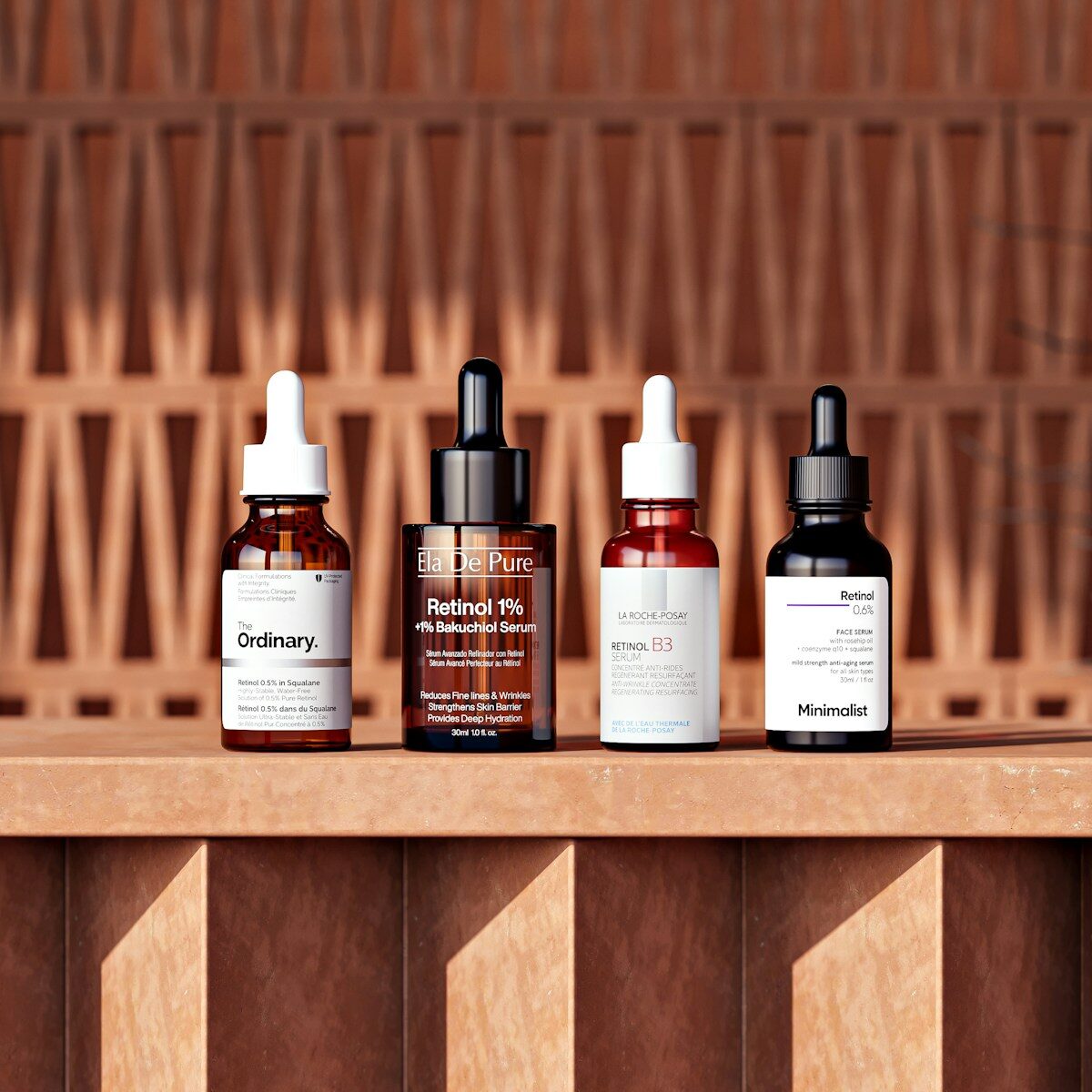
The Clinical Hook
The most common cause of a routine that stops working is not a bad ingredient. It is a good ingredient used at the wrong time, next to the wrong partner, on skin that has already had enough. Retinoids, vitamin C and exfoliating acids are the three most effective cosmetic categories in modern skincare, and they are also the three most often combined into a single evening routine by enthusiastic readers who assume that more actives must mean faster results. The question of what not to layer is therefore not a question about weak ingredients. It is a question about load: how much chemical work one barrier can absorb in one sitting before the surface starts to look worse — tighter, flakier, redder-looking — than it did before the routine began.
Clinical TL;DR
- What not to layer in one sitting is the trio at full strength together: a retinoid, a strong exfoliating acid and a potent vitamin C, all applied in the same routine.
- Clashes happen through three mechanisms, not one: pH interference, where an acidic formula changes the environment another active needs; penetration and irritation load, where several strong actives demand tolerance at once; and barrier budget, where the skin’s repair capacity for the day is simply spent.
- Retinoids and strong acids are the most demanding pairing. Separating them — different nights, or different times of day — is the single highest-value change an overloaded routine can make.
- Vitamin C is not one ingredient but a family. Pure L-ascorbic acid is the most pH-sensitive member; stabilised derivatives are far more forgiving partners, which is why the form matters as much as the name.
- The concern underneath every clash is the same: a barrier pushed past its comfort, showing up as tightness, flaking, stinging on application and a dull, uneven-looking surface.
- The fix is separation, not abandonment: rotate actives across the week, introduce one at a time, and keep a barrier-first recovery step in reserve for the nights when enthusiasm outruns tolerance.
Why Potent Actives Clash: Three Mechanisms
A clash is not a chemical explosion in a bottle. In most home routines it is a quieter failure: two or three well-formulated products, each reasonable alone, whose combined demand exceeds what the skin’s surface can comfortably process in one application.
The first mechanism is pH interference. Several classic actives are formulated at a distinctly acidic pH because their chemistry requires it, and several others are most comfortable near the skin’s own mildly acidic surface. Layering a strongly acidic formula directly beneath another active changes the environment that second active meets, and can shift how it behaves on the surface. The effect is most real for the oldest, least stabilised forms, above all pure L-ascorbic acid.
The second mechanism is penetration and irritation load. Exfoliating acids loosen the bonds between surface cells; that is their cosmetic function, and it is also why they change what happens next. A surface that has just been exfoliated is a more permeable surface, so a retinoid applied immediately afterwards meets less resistance and can feel considerably stronger than the same retinoid applied to an unexfoliated surface. The visible result is the familiar sting, flush and flaking that readers often misread as the product “working”.
The third mechanism is barrier budget. The stratum corneum — the skin’s outermost brick-and-mortar layer of corneocytes and lipids — repairs itself continuously, but not infinitely fast. Every strong active spends some of that repair capacity, and a routine that spends it three times over in one evening leaves the surface under-defended overnight, when water loss is already at its highest. The visible signature is not dramatic: skin that feels tight after washing, looks dull rather than luminous, and stings when a previously comfortable moisturiser is applied. That sting is useful information, not a badge of progress.
The Skin Concern It Addresses: Irritation and Barrier Strain
Every ingredient post in this series names the concern it serves, and this one serves a concern that is usually misdiagnosed: the appearance of irritation that follows an ambitious routine. Tightness, flaking, a flushed look after application, and products that suddenly sting are routinely read as sensitivity to one ingredient, and the usual response is to discard that ingredient and buy another strong one. More often the cause is cumulative load. The surface is not reacting to a single villain; it is reporting that three strong demands arrived at once.
Retinoids and Acids: The Classic Overload
Retinoids — retinol, retinal and their gentler relatives — are the evening anchor of most prosumer routines, and exfoliating acids — glycolic, lactic and salicylic acids among them — are the texture and clarity tools. Used on separate nights, each is well tolerated by most skin that has been introduced gradually. Used in the same sitting at full strength, they are the pairing most likely to produce the overloaded look described above, for a straightforward reason: the acid increases permeability and the retinoid then arrives at a surface with its defences lowered.
The practical rule is separation, and it is more forgiving than the folklore suggests. A retinoid night and an acid night, alternating across the week, give the reader both benefits without the combined load. Readers who want both in one evening should treat that as an advanced move, not a starting point: a gentler acid, a lower retinoid frequency, and a barrier moisturiser as the buffer layer, with the whole combination abandoned for a recovery night at the first sign of tightness or flaking. Beginners, and anyone rebuilding after a period of over-exfoliation, should not attempt the combined evening at all.
There is one nuance worth keeping. Not every acid behaves identically here. A rinse-off cleanser containing a mild exfoliating acid, used briefly and washed away, spends far less barrier budget than a leave-on acid serum layered beneath a retinoid. The clash is a function of strength, contact time and sequence, not of the acid name alone. The companion guide to retinoid tolerance sets out the gradual introduction protocol that makes retinoids sustainable: frequency first, strength second, and a barrier-first frame around both.
Vitamin C and Acids: A pH Problem, Mostly for One Form
Vitamin C’s reputation for clashing with acids rests almost entirely on its oldest form. Pure L-ascorbic acid is formulated at a distinctly acidic pH and is famously sensitive to light, air and pH change; layered directly beneath or above a strong exfoliating acid, it can sting, and its behaviour on the surface becomes harder to predict. That is a genuine, if modest, incompatibility — and it is also the easiest to sidestep, because vitamin C is a family, not a single ingredient.
Stabilised derivatives — sodium ascorbyl phosphate, magnesium ascorbyl phosphate, ascorbyl tetraisopalmitate and 3-O-ethyl ascorbic acid among them — were developed precisely to be less pH-sensitive and gentler in use, and they are far more forgiving partners for a routine that also contains acids. The choice is therefore not between vitamin C and acids, but between forms: if the routine already carries a strong acid, a stabilised derivative is the sensible vitamin C, and the pure acid belongs on a different morning, or in a simpler routine. The comparison of stabilised vitamin C derivatives evaluates each form on stability, gentleness and cosmetic role, so the reader can choose by routine rather than by marketing claim.
Within Skin001’s formulation framework, this is the role of SKINVC™, the stabilised vitamin C compound: a morning vitamin C designed to sit comfortably in a routine that also has evening actives, rather than a pure-acid formula that demands a routine built around it.
Retinoids and Vitamin C: Timing, Not Banning
The retinoid–vitamin C pairing is the most misunderstood of the three, because the warning against it is stated far more absolutely than the evidence supports. The concern is again partly pH: a pure, acidic vitamin C and a retinoid applied in the same sitting can irritate, and the two actives compete for the skin’s tolerance budget in a way that makes the combination feel stronger than either alone. But this is a timing problem with a simple solution, and the solution is already the standard prosumer routine: vitamin C in the morning, retinoid in the evening.
Separated by twelve hours, the two categories are not merely compatible but complementary in cosmetic role — vitamin C for daytime antioxidant appearance and tone-evenness, retinoid for overnight renewal appearance. Readers who insist on a single routine should choose a stabilised vitamin C derivative for that routine and keep the pure acid for a morning of its own. Readers who keep the split need no further rule; the split is the rule.
What Not to Layer in a Single Routine
The combinations below are the ones that most reliably produce the overloaded look. They are stated as single-sitting rules, not lifetime bans: almost every ingredient here earns its place in a weekly routine, just not in the same application.
- A retinoid plus a strong leave-on exfoliating acid, in the same evening. The acid increases permeability and the retinoid arrives harder. Separate them across nights.
- Pure L-ascorbic acid plus a strong exfoliating acid, in the same sitting. The most pH-sensitive vitamin C form meeting a strongly acidic partner. Use a stabilised derivative instead, or separate the two.
- Two exfoliating acids at full strength, layered together. Glycolic over salicylic over lactic is not a stronger routine; it is the same mechanism spent twice, with the barrier paying the difference.
- A retinoid plus a strong acid plus a potent vitamin C, all in one routine. The trio that gives this article its title. No single product in the trio is the problem; the total load is.
- Any strong active introduced on the same week as another new strong active. When two new products arrive together and the surface reacts, there is no way to know which one to blame — and the usual response, discarding both, wastes two good ingredients. One new active at a time, judged over two to three weeks, is the only introduction protocol that produces usable information.
- A strong active over skin that is already stinging, flaking or tight. This is the rule that overrides all others. A barrier reporting distress is not a surface to push through; it is a surface asking for a recovery night.
What, then, is safe to layer in one sitting? The combinations that spend little barrier budget: a gentle hydrating serum beneath a barrier moisturiser, a stabilised vitamin C derivative under sunscreen in the morning, a single active over a calm, well-moisturised surface. The pattern is consistent. Calm layers combine freely; demanding layers take turns.
Prosumer Application: A Week That Separates Actives Safely
A workable week is less exciting than an ambitious evening, and that is its virtue. The template below keeps all three categories in play without ever stacking them, and it can be adjusted by moving nights rather than by adding products.
Monday and Thursday evenings belong to the retinoid: cleanse gently, apply the retinoid to a dry surface, follow with a barrier moisturiser, and nothing else that demands tolerance. Tuesday evening, if texture or clarity is the goal, belongs to the exfoliating acid — again alone, again followed by barrier support. Mornings belong to vitamin C, preferably a stabilised form, layered under moisturiser and sunscreen. Wednesday, Saturday and Sunday evenings are deliberately quiet: barrier care only, or no active at all. Those quiet nights are not wasted nights. They are the nights the barrier rebuilds.
Two disciplines hold the template together. The first is single introduction: when a new active enters the routine, everything else stays fixed for two to three weeks, so any change in the skin’s appearance can be attributed honestly. The second is the recovery step. When a routine has been over-ambitious — the sting, the flaking, the tight feeling after washing — the correct response is not a new product but a pause: a night or three of barrier care only, with the actives waiting. Within Skin001’s formulation framework, this is the role of RESERUM™, the reset base designed for over-exfoliated-feeling skin: not a treatment for any condition, but a calm, barrier-first step that gives an overloaded surface a dignified way back to its normal routine. The companion post on transepidermal water loss explains why that pause works in barrier terms: water loss through a compromised surface is the number that decides whether calm-looking skin returns quickly or keeps slipping, and a recovery step that seals the surface is what lets that number fall.
Patch testing belongs in the same discipline, not as an afterthought. A new active is tested on a small area — jawline or behind the ear — for several days before it earns a place on the full face, and a product that stings on first application is not pushed through on the theory that discomfort proves efficacy. Discomfort proves load.
FAQ
Can I use retinol and vitamin C on the same day?
Yes, separated by time of day: a vitamin C in the morning and a retinoid in the evening is the standard prosumer split. The combination to avoid is the two at full strength in the same sitting, particularly with pure L-ascorbic acid.
Can I mix retinol and glycolic acid?
Not in the same evening at full strength. The acid increases surface permeability, so the retinoid that follows can feel considerably stronger than expected. Alternate them across nights instead, and treat any combined evening as an advanced move with a gentler acid and a barrier moisturiser as buffer.
Is it safe to use vitamin C and AHAs together?
With a stabilised vitamin C derivative, usually yes in a normal routine; with pure L-ascorbic acid layered directly over or under a strong acid, the pairing is more likely to sting and is best separated. The form of vitamin C decides the answer, not the category name.
How do I know my routine has too many actives?
The surface reports it plainly: tightness after washing, flaking, stinging when a previously comfortable moisturiser is applied, and a dull, uneven-looking surface rather than a luminous one. Those signs call for separation and recovery nights, not for another active.
The CTA
The lesson of what not to layer is, in the end, a lesson about respect for the surface doing the work. Retinoids, vitamin C and acids are not rivals, and none of them needs to be feared or discarded. They need what every demanding ingredient needs: their own night, their own morning, and a barrier that is allowed to recover between performances. A routine built on separation will look less dramatic on a shelf and more luminous on skin — which is the only measure that matters. Explore Skin001’s pure compound ingredients and build a routine that gives each active the space to do its best work.