The Clinical Hook
Almost everyone has tried to fix dark circles with a single cream, and almost everyone has been disappointed by at least one of them. The reason is rarely that the cream was bad. It is that “dark circles” is not one problem. It is four different appearances sharing one small patch of skin: pigment sitting in the surface, blood vessels showing through thin skin, a hollow casting a shadow, and a night of poor sleep compressing all three into something that looks worse by morning. A product aimed at one cause cannot fix the other three, and a routine that treats all four as if they were the same thing will always feel like it is failing.
The under-eye area makes this confusion almost inevitable. The skin there is among the thinnest on the face, it has very little fat beneath it, and it sits directly over a network of small vessels and a bone structure that changes with age. That thinness is why everything underneath shows: colour in the skin, colour in the blood, and the shape of the bone itself. Deconstructing dark circles means learning to read which of those three things — plus sleep — you are actually looking at, before choosing anything to put on it.
Clinical TL;DR
- Dark circles causes fall into four groups: pigmentary (extra melanin in the under-eye skin), vascular (blood vessels showing through thin skin, often with a blue or purple cast), structural (a hollow or tear trough casting a shadow), and sleep-related compression (fluid, puffiness and dullness that make any of the first three look worse).
- The quickest diagnostic is the stretch test and the mirror test: pigment stays put when the skin is gently stretched, vascular colour shifts, and a shadow that moves when you tilt your face toward the light is structural, not pigment at all.
- The four ingredients evaluated below map to causes, not to the whole problem: niacinamide to the appearance of uneven tone, vitamin K1 and caffeine-bearing botanicals to the appearance of vascular colour and morning puffiness, and acetyl tetrapeptide-5 to the appearance of fluid-related puffiness.
- No eye cream fills a hollow, and no concealer fixes a cause. Matching the product to the cause is the whole strategy — and a persistent, one-sided or painful change is a clinician’s question, not a cosmetic one.
- Cosmetic language applies throughout: this article addresses the appearance of darkness and tiredness. It does not treat disease, and it claims no measured outcome for any ingredient.
Four Causes, One Small Patch of Skin
Pigmentary dark circles are the most familiar kind, and the easiest to misread. Extra melanin in the under-eye skin produces a brown cast that is there in the morning, there in the evening, and unchanged by a good night’s sleep. It is more common in deeper skin tones and in skin with a history of rubbing, eczema or sun exposure around the eyes, because all three can leave pigment behind. The companion post on pigment pathways explains the melanin machinery in full; the under-eye version of the story is the same machinery in thinner skin, where even a modest amount of extra pigment is visible because there is so little skin to hide it. The stretch test is the giveaway: gently stretch the lower-lid skin, and pigmentary darkness stays dark, because the colour is in the skin itself, not underneath it.
Vascular dark circles look blue, purple or pink, and they behave differently. The colour here is not in the skin but beneath it: small vessels showing through skin so thin that their colour reads on the surface. That is why vascular circles change with the day — they look worse when you are tired, congested, dehydrated or have been crying, because all of those states change how much blood is near the surface and how visible it is. They also change with the stretch test: pull the skin gently taut and the colour shifts or fades, because you have changed the relationship between the skin and the vessels beneath it. Fair, thin skin shows this kind most readily, and it is the kind most often mistaken for pigment, which is why pigment products so often “fail” on it — they were aimed at the wrong layer.
Structural dark circles are not a colour problem at all. They are a shadow problem. With age, and in some faces from youth, the fat pad under the eye thins and the tear trough — the groove between the lower lid and the cheek — deepens. Light falling from above then casts a shadow into that groove, and the eye reads the shadow as darkness. The mirror test identifies it: tilt your face up toward a light source and the darkness lifts, because the shadow has moved; tilt it down and the darkness deepens. No cream, however good, fills a groove, and recognising a structural circle matters precisely because it stops a search for a product that cannot exist. Cosmetics can soften the appearance of the area around a hollow, and a light-reflecting concealer can lift it optically, but the honest statement is that the hollow itself is anatomy, not a skin-care failure.
Sleep compression is the fourth cause, and it is really an amplifier. Poor sleep does not create pigment or a hollow, but it makes everything else look worse in three ways at once: fluid collects under the eyes overnight, so puffiness adds a second shadow; the skin looks paler and duller, so any colour underneath contrasts more sharply; and the vessels beneath thin skin become more prominent. That is why the same eyes can look acceptable after a rested week and alarming after two short nights, and why “I slept badly” is a genuine explanation rather than an excuse. Sleep compression is also the most reversible of the four — which makes it the best place to start, because it costs nothing and it clarifies what remains once it is removed.
Most real under-eyes are a mixture. A common combination is pigment plus vascular colour, or a shallow hollow plus sleep-related puffiness, and the mixture is why single-cause products disappoint: they improve one quarter of the picture and leave the rest untouched, so the overall impression barely moves. The deconstruction is the treatment plan, in the sense that it tells you where to spend attention and where to stop spending it.
The Four Ingredients, Matched to Causes
Niacinamide is the tone ingredient, and its under-eye role is the pigmentary one. Niacinamide is discussed in the pigment literature as interfering with the transfer of melanin from melanocytes to the surrounding skin cells, which in appearance terms means it addresses uneven tone rather than bleaching skin. Around the eyes, that makes it the sensible choice for the brown, stay-put darkness of the pigmentary type — used consistently, in a finished eye product, as part of a routine that also includes sun protection, since ultraviolet exposure is one of the drivers that keeps pigment returning. It will not change a vascular circle, because there is no extra melanin to address, and it will not fill a hollow. Judged against the right cause, though, it is the best-behaved tone ingredient available: well tolerated by most skin, including the thin skin of the eye area, and compatible with the other ingredients below.
Vitamin K1 is the vascular ingredient, and it comes with the most careful language in this article. Vitamin K is involved in the body’s handling of blood and bruising, and in cosmetic discussion it is associated with the appearance of vascular discoloration — the blue-purple cast of blood showing through thin skin. That association is the reason it appears in eye products aimed at vascular circles, and the honest framing is exactly that: an association discussed in cosmetic literature, not a treatment for any vascular condition. Anyone whose under-eye darkness appeared suddenly, on one side only, or together with pain, swelling or vision changes should not be shopping for vitamin K at all — that presentation belongs with a clinician, promptly. For the ordinary, long-standing, both-sides vascular cast, vitamin K1 is a reasonable ingredient to look for in a finished eye cream, judged on the appearance of the area over weeks, not days.
Caffeine-bearing botanicals — green tea, coffee extract and their relatives — are the morning ingredient. Caffeine is discussed in cosmetic terms as temporarily constricting the small vessels near the surface, which in appearance terms can make vascular colour look less prominent for a few hours, and as supporting the appearance of a less puffy morning eye. The key word is temporarily: caffeine does not change the vessels, the skin thickness or the pigment, and its effect fades as the day goes on. That makes it a good morning step rather than a long-term strategy — the ingredient that makes the mirror kinder at nine in the morning while the slower ingredients do their work underneath. It pairs naturally with a cooling applicator or a chilled product, not because cold is an active ingredient, but because the combination addresses the morning fluid picture from two angles at once.
Acetyl tetrapeptide-5 is the fluid ingredient, and the most specialised of the four. Peptides are short chains of amino acids, and this one is discussed in cosmetic literature in connection with the appearance of fluid retention under the eyes — the puffy, swollen look that sleep compression and slow fluid drainage produce. In appearance terms, it is aimed at the puffiness component rather than the colour component: an eye that looks swollen will read as darker even when its pigment is unchanged, because the swelling casts its own small shadow. Acetyl tetrapeptide-5 therefore belongs in the routine of the reader whose chief complaint is morning puffiness that softens by afternoon, rather than the reader whose darkness is a fixed brown or blue cast. Like every peptide in this blog, it is discussed as a cosmetic ingredient in a finished product, not as a drug, and its effect is judged on appearance over weeks of consistent use.
Read together, the four form a cause-matched set, not a stack: niacinamide for pigmentary tone appearance, vitamin K1 for vascular colour appearance, caffeine for the morning vascular and puffy picture, and acetyl tetrapeptide-5 for fluid-related puffiness appearance. A product containing all four is not automatically better than one containing two — what matters is whether the two it contains match the causes you actually have.
Prosumer Application: Reading Your Own Eyes, Then Acting
Start with the tests, on a rested morning, in natural light. First, the stretch test: gently stretch the lower-lid skin sideways and watch the colour. If it stays, you are looking mainly at pigment. If it shifts or fades, the vascular layer is doing most of the work. Then the mirror test: tilt your face up toward the light, then down. If the darkness moves with the light, a hollow is contributing, and no cream should be expected to remove it. Finally, the sleep test, which takes a week rather than a minute: after several nights of genuinely good sleep, what remains is your baseline, and that baseline — not the worst morning — is what any product should be judged against.
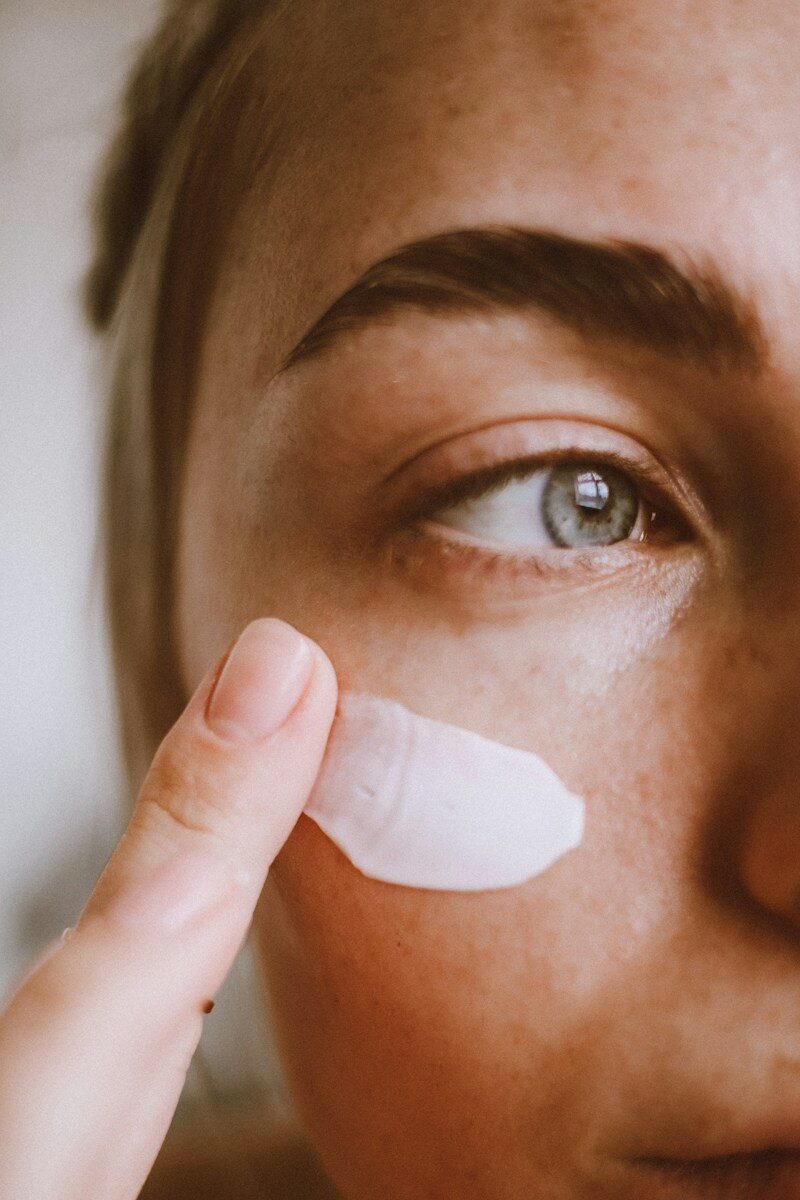
Then build the routine around the answer, keeping the eye area’s thinness in mind. The companion post on the barrier-lipid alphabet explains why the skin’s own mortar matters, and the eye area is where that lesson bites hardest: thin skin with a thin barrier tolerates less, so introduce one eye product at a time, use a pea-sized amount for both eyes, and pat rather than rub, because chronic rubbing is itself a driver of pigment. Apply eye products before heavier face creams so they are not diluted, and keep sun protection in the routine — ultraviolet exposure drives pigment, and the eye area is often missed by sunscreen application. The companion post on the expensive barrier cream makes the same point at face scale: judge a product by its whole architecture, not by its hero name, and price is the last question, not the first.
Within Skin001’s formulation framework, this is the role of EYEHUE™: an eye-area system presented as the applied example of cause-matched eye care — tone, vascular appearance and puffiness appearance addressed together, in a finished product designed for thin under-eye skin — rather than around a single hero claim. As with every soft-embed in this blog, that is positioning and design intent, not a claim about measured outcomes. And the guardrail that governs all eye-area work applies here with full force: work with finished or semi-ready compounds, follow their label directions, keep products out of the eye itself, and let a clinician own anything that looks medical.
FAQ
How do I tell pigment circles from vascular circles?
Use the stretch test: gently stretch the lower-lid skin. Pigmentary darkness stays dark because the colour is in the skin; vascular colour shifts or fades because it sits beneath the skin. Brown that never changes suggests pigment; blue or purple that changes with tiredness, congestion or the stretch suggests vessels.
Can an eye cream fix a hollow under my eyes?
No. A hollow is a structural shadow, not a skin problem, and no topical product fills it. Cosmetics can soften the appearance of the surrounding area and a light-reflecting concealer can lift it optically, but the hollow itself is anatomy. Recognising this saves money and disappointment.
Why do my dark circles look worse after a bad night?
Because poor sleep amplifies all three other causes at once: fluid collects and adds puffiness, the skin looks paler so underlying colour contrasts more, and vessels near the surface become more prominent. After several rested nights, what remains is the true baseline to judge any product against.
Is caffeine in eye cream just a temporary fix?
In appearance terms, yes — and that is its proper role. Caffeine is discussed as temporarily making vascular colour and morning puffiness look less prominent, which makes it a good morning step. It does not change pigment, skin thickness or anatomy, so it belongs alongside slower ingredients, not instead of them.
When should dark circles be seen by a clinician?
Promptly, if the darkness is one-sided, painful, swollen, rapidly changing, or accompanied by vision changes, or if it appeared suddenly without an obvious cause. Those presentations are not cosmetic questions, and no eye cream should be tried first.
The CTA
Stop buying a single cream for four different problems. Read your own eyes first — stretch, mirror, sleep — then match the product to the cause you actually have, and judge it against your rested baseline, not your worst morning. Explore Skin001’s pure compound ingredients and bases, and judge each one the same way this article judges them: not by the promise on the jar, but by whether it addresses the layer your darkness actually lives in.