The Clinical Hook
Bio-identical lipids are one of the most persuasive phrases in modern skincare — and one of the least examined. A lipid that is “bio-identical” is, by definition, a lipid whose structure matches a lipid the skin itself makes. The claim sounds simple, but it carries a real question underneath it: does matching the skin’s own chemistry actually change how a product behaves on the surface, or is it simply a more elegant way of saying “oil”? Some lipids are genuinely identical to the skin’s own barrier fats, and they behave differently from ordinary oils because of it. Others borrow the language while offering a structure the skin would never recognise. This spotlight explains the difference — and introduces Lipid21™, Skin001’s bio-identical lipid drop, as the applied example.
Clinical TL;DR
- Bio-identical lipids match the lipids the skin itself produces: ceramides, cholesterol and free fatty acids in their skin-native forms.
- The barrier’s job is to hold water in and keep irritants out; when its lipid mortar is depleted, water escapes as transepidermal water loss and skin feels tight, dry and reactive.
- Ordinary oils sit on the surface or dissolve into the skin’s lipids at random; bio-identical lipids are shaped to slot into the barrier’s existing architecture.
- The three barrier lipids work as a system: ceramide provides structure, cholesterol provides flexibility, and free fatty acids provide packing — and the ratio between them matters more than any single ingredient.
What “Bio-Identical” Means in Lipid Chemistry
The term “bio-identical” has a precise meaning and a loose one, and the skincare shelf uses both. In its precise sense, a bio-identical lipid is a molecule with the same chemical structure as a lipid the human body produces. Ceramide NP is bio-identical when it is the same N-stearoyl phytosphingosine the skin synthesises — not merely a ceramide-like molecule. Cholesterol is bio-identical when it is cholesterol itself, the same sterol that sits in every cell membrane. Squalane is bio-identical in a looser sense: the skin makes squalene, and squalane is its hydrogenated, stable cousin — close enough in behaviour to count as functionally identical.
The loose sense of the term is where the reader should be careful. Any plant oil can be described as “natural” or “skin-friendly,” but that does not make it bio-identical. Olive oil, coconut oil and sweet almond oil are triglycerides — three fatty acids attached to a glycerol backbone — and the skin’s barrier does not contain triglycerides in any significant amount. They can feel pleasant and they can occlude, but they do not slot into the barrier’s architecture the way a ceramide or a free fatty acid does.
Why does structural identity matter? The barrier is not a wall of random grease. It is an organised structure — the familiar “bricks and mortar” model, in which corneocytes are the bricks and the lipid matrix between them is the mortar. That mortar is not amorphous: its lipids arrange themselves into stacked layers, called lamellae, and the geometry of those layers depends on the shapes of the molecules in them. A lipid with the right chain length and head group fits into the lamellae; a lipid with the wrong shape disrupts them or floats on top. Bio-identical lipids fit because they are the molecules the lamellae were built from.
The Barrier’s Lipid Mortar: Ceramides, Cholesterol and Free Fatty Acids
Three lipid families make up the barrier mortar, in roughly equal proportions by weight, and each one does a job the others cannot.
Ceramides are the structural backbone. They are the most abundant lipid in the stratum corneum by weight, and their long, straight chains pack tightly together to form the dense layers that slow water movement. The ceramide alphabet post mapped the family in detail — NP, AP and EOP and their relatives — and the essential point for this spotlight is that each ceramide has a defined role: some anchor the layers together, some span the full width of the lamellae, and some provide the very-long chains that give the barrier its tightness. When ceramide levels fall — with age, with over-exfoliation, with harsh cleansing — the mortar thins and water escapes faster.
Cholesterol is the flexibility agent. It sits between the ceramide chains and keeps them from packing too rigidly, which matters because a barrier that is too stiff cracks, and a barrier that is too fluid leaks. A formula that supplies ceramides without cholesterol is supplying structure without flexibility — better than nothing, but not a complete system.
Free fatty acids are the packing agents. They fill the gaps between ceramide and cholesterol, and their chain lengths tune how tightly the layers sit. The skin’s own fatty acids are predominantly long-chain and saturated — stearic acid, palmitic acid — with smaller amounts of unsaturated acids such as linoleic acid, which plays a distinct role in the barrier’s organisation. A free fatty acid that matches the skin’s own chain lengths packs neatly; one that is too short or too kinked loosens the structure instead.
The ratio between the three families is the point most often missed. Research on barrier models has repeatedly shown that an equimolar balance — roughly equal parts ceramide, cholesterol and free fatty acid — supports the most organised lamellar structure, while a formula dominated by any single family underperforms. This is why the expensive barrier cream teardown asked the ratio question rather than simply counting ceramides on the label: a cream can list five ceramides and still be unbalanced.
Where Bio-Identical Lipids Differ From Ordinary Oils
The practical difference between a bio-identical lipid and an ordinary oil shows up in three places: placement, persistence and compatibility.
Placement first. An ordinary oil, applied to the surface, forms a film. It can reduce water loss by occlusion — the same way a layer of petroleum jelly does — and that is a genuine benefit, but it is a surface benefit. A bio-identical lipid, because its shape matches the barrier’s own molecules, can integrate into the lipid matrix between corneocytes rather than sitting entirely on top of it.
Persistence second. Oils that do not match the barrier’s architecture are removed faster by cleansing, by friction and by the skin’s own turnover, because nothing holds them in place. Lipids that fit the lamellar structure are retained longer, because they are part of the structure. This is one reason a well-formulated ceramide product can show a lasting effect on the feeling of dryness while a plain oil feels good for an hour and then fades.
Compatibility third. Bio-identical lipids are, by definition, molecules the skin already handles. That does not make them incapable of causing a reaction — any ingredient can irritate a sensitised individual, and patch testing still applies — but it does mean they do not introduce a foreign structure the skin must work around. For the reader whose barrier is already compromised, that familiarity is the practical advantage: the lipid drop speaks the skin’s own language rather than asking it to translate.
None of this means ordinary oils are useless. Squalane, for example, is a superb emollient precisely because it is close to the skin’s own sebum. The point of this spotlight is narrower: when the goal is barrier support rather than surface feel, structural identity is the property that matters.
The Skin Concern It Addresses: Dryness, Tightness and Barrier Depletion
The skin concern behind bio-identical lipids is the cluster of sensations every reader recognises: skin that feels tight after washing, dryness that returns within hours of moisturising, a surface that looks dull and feels reactive to products that once caused no trouble. The mechanism behind those sensations is the one the transepidermal water loss post describes: when the lipid mortar thins, water escapes faster than the skin can replace it, and the stratum corneum dries from the inside out. Moisturisers that supply only humectants — glycerin, hyaluronic acid — can draw water in, but without a sound lipid layer that water leaves again. The concern is therefore not a lack of moisture in the abstract; it is a structural gap in the barrier, and the ingredient that addresses it is the one that fills the gap with matching material.
Reading a Bio-Identical Lipid Drop: What the Label Should Show
A reader evaluating a bio-identical lipid product should look for four things on the label, in this order.
First, named lipids, not vague claims. The label should name its ceramides (NP, AP, EOP or their INCI equivalents), its cholesterol, and its free fatty acids by name. A product that says “barrier lipids” without naming any of them is asking the reader to trust the claim without evidence. A product that names them is making a checkable statement.
Second, balance across the three families. A drop that contains ceramides alone is a partial system. The strongest barrier-support formulas include all three families — ceramide, cholesterol and free fatty acid — because the lamellar structure needs all three.
Third, a delivery format that suits the lipids. Ceramides are notoriously difficult to keep stable and available in a formula: they crystallise, they precipitate, and they need a carrier that keeps them dispersed until they reach the skin. A lipid drop — an oil-based or emulsion-based carrier — is a sensible format precisely because it dissolves the lipids in a compatible medium. A watery serum that claims high ceramide content deserves scepticism, because ceramides do not dissolve in water.
Fourth, the company the lipids keep. A bio-identical lipid drop that also contains squalane, a humectant such as glycerin, or a calming botanical is a drop built for real skin rather than for a laboratory model. A drop that pairs its lipids with fragrance or with a high load of essential oils is a drop that may undo its own barrier work on reactive skin.
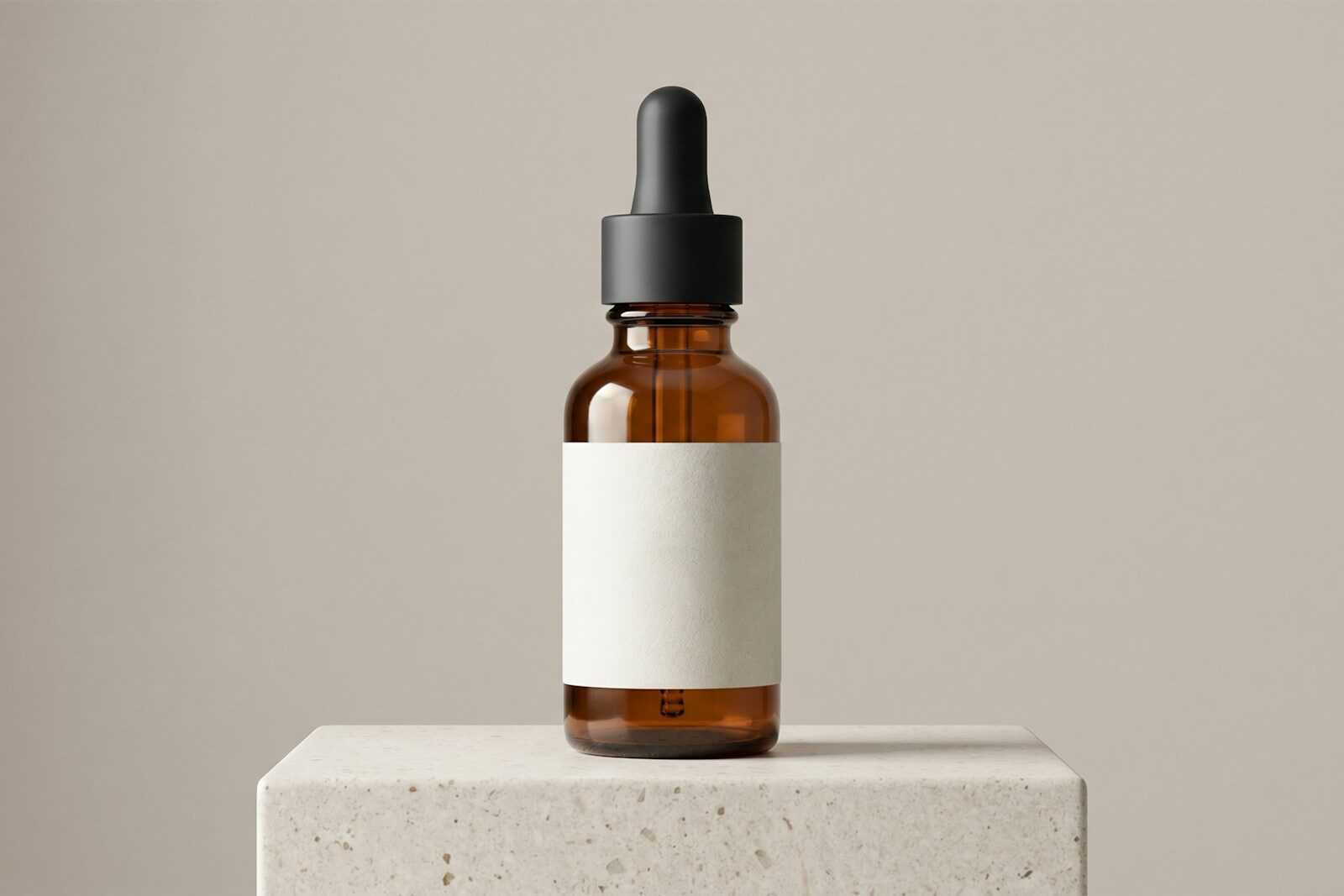
Within Skin001’s formulation framework, this is the role of Lipid21™: a bio-identical lipid drop built around the skin’s own barrier lipids, designed to be used alongside serums and creams rather than instead of them. It is the applied example of the science this post teaches — a drop whose lipids are chosen to match the barrier’s architecture, in a carrier that keeps them available. The spotlight rule applies here as it does throughout this site: the system is introduced as the example, not as the argument. The argument is the chemistry above, and it stands on its own.
Prosumer Application: Layering a Lipid Drop Safely at Home
For the reader working with finished or semi-ready compounds at home, a bio-identical lipid drop is one of the most forgiving steps in a routine — and one of the most often misplaced. Apply the drop after water-based steps and before, or mixed with, a cream. The order is: cleanse gently, apply humectant serums such as hyaluronic acid while the skin is still slightly damp, then the lipid drop, then a moisturiser if the skin still feels in need of one. The logic is that the drop’s lipids need a hydrated surface to seal: a lipid layer over dry skin seals in dryness, while a lipid layer over hydration seals in water. Two to four drops, warmed between the palms and pressed onto the face and neck, is a typical amount; more is not better, and a greasy film is a sign of over-application rather than of extra benefit.
The drop pairs well with almost everything, which is one of its strengths. It sits comfortably over vitamin C in the morning and under a retinoid at night — indeed, a lipid drop is one of the best companions for a retinoid routine, because it supports the barrier the retinoid is stressing. It layers cleanly under sunscreen in the morning, provided the reader waits a few minutes for the drop to settle before applying the filter. It can be mixed into a moisturiser for a richer finish on cold days, or used alone as the last step on humid days when a cream would feel heavy.
Introduce the drop the way any new step should be introduced: patch test on the jawline for two or three days, then use it once daily for a week before deciding whether to move to twice daily. If the skin feels congested or if breakouts appear, reduce the amount before abandoning the product — most lipid-drop complaints are dose complaints, not ingredient complaints. And keep expectations cosmetic: a bio-identical lipid drop helps skin look and feel less dry, less tight and more resilient in appearance. It does not rebuild the barrier overnight, and it does not treat any skin condition. The improvement is gradual and cumulative, and most visible in the morning, when the skin that was supported overnight looks calmer than the skin that was not.
FAQ
Are bio-identical lipids the same as natural oils?
No. A bio-identical lipid has the same chemical structure as a lipid the skin itself makes — a ceramide, cholesterol or a skin-native free fatty acid. Most natural plant oils are triglycerides, which the barrier does not contain in significant amounts. Both can be useful, but they work by different mechanisms.
Can a lipid drop replace my moisturiser?
For some readers, on humid days, yes — a drop can be the last step on its own. For most readers, it works best as a support step under or mixed with a moisturiser, because the moisturiser supplies humectants and a second occlusive layer that the drop alone does not provide.
How long does it take to see a difference?
The feeling of reduced tightness often appears within days, because the drop immediately reduces water loss from the surface. A visible change in the appearance of dryness and resilience is usually a matter of weeks, as the barrier’s lipid organisation improves with consistent use.
Are bio-identical lipids safe for reactive or acne-prone skin?
They are generally well tolerated because they match the skin’s own chemistry, but any ingredient can irritate a sensitised individual. Patch test on the jawline first, start with a small amount, and stop if irritation appears. Readers with a diagnosed skin condition should follow their clinician’s guidance.
The CTA
Bio-identical lipids earn their name by a testable fact: they are the same molecules the skin’s own barrier is built from. Ceramides give the barrier its structure, cholesterol gives it flexibility, and free fatty acids give it packing — and the three work as a system, in balance, rather than as a single hero ingredient. An ordinary oil can occlude and soften, but it cannot slot into the lamellar architecture the way a matching lipid can. That is the difference that makes a bio-identical lipid drop a support step worth understanding rather than a marketing phrase worth ignoring.
For readers building a barrier-first routine with Skin001’s compound approach, the next step is to explore Skin001’s pure compound ingredients and bases, and to pair a bio-identical lipid drop such as Lipid21™ with the hydration and active steps the rest of this site describes.