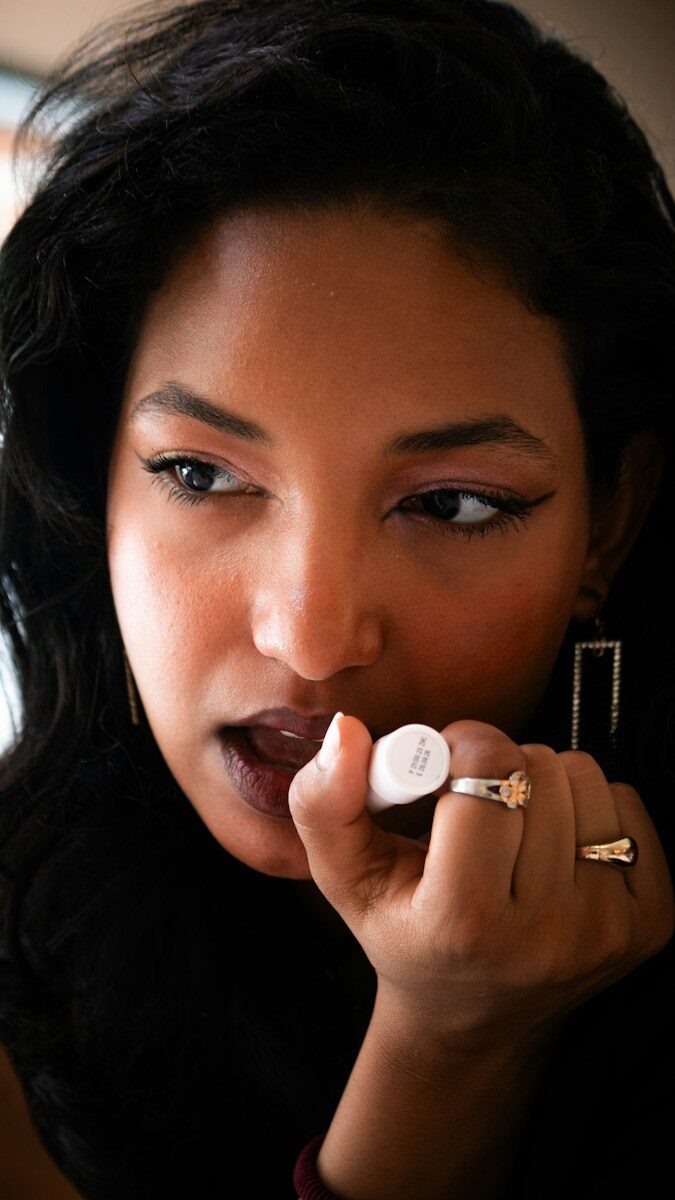
The Clinical Hook
Dry lips do not behave like dry facial skin, and treating them the same way is why so many lip balms feel like a short-term fix. A face cream that restores comfort to the cheeks can leave the lips peeling again within the hour, and a lip product that feels soothing on application can make the cycle worse by the evening. The difference is not a failure of effort. It is anatomy. The lip barrier is a thinner, differently built structure with no oil glands of its own, no protective pigment, and a surface that is wet, moved and wiped dozens of times a day. This article explains what the lip barrier actually is, why it loses water faster than facial skin, which ingredients genuinely support it, and which habits quietly undo the repair.
Clinical TL;DR
- The lip barrier is a thin stratum corneum over the vermilion — the red part of the lip — with far fewer cell layers than facial skin and no sebaceous glands to supply its own lipids.
- Lips lose water faster than facial skin through transepidermal water loss, and the loss is worsened by licking, cold dry air, indoor heat and constant movement.
- The ingredients that support the lip barrier are barrier lipids and occlusives: ceramides, squalane, shea butter and lanolin-type occlusives, each doing a different job.
- Flavouring agents, menthol, camphor and aggressive exfoliation can make lips feel worse even when a product feels pleasant on application.
- A lip-barrier routine is mostly protection and patience: a lipid-rich balm, reapplied after eating and drinking, with no scrubbing and no picking at flakes.
The Lip Barrier Is Not Facial Skin
The red part of the lip — the vermilion — is transitional tissue. It is neither the keratinised skin of the face nor the wet mucosa inside the mouth, but a narrow strip between the two, and its construction explains almost everything about how lips behave. The stratum corneum of the vermilion is only three to five cell layers thick, compared with roughly fifteen to twenty on the cheek. The corneocytes themselves are smaller and less tightly packed, and the lipid matrix between them is thinner. That thinness is also why lips look red: the blood vessels of the dermis show through a translucent surface with very little melanin to filter the colour.
Three absences define the lip barrier more than any feature it possesses. First, lips have no sebaceous glands, so they produce no sebum and receive no natural lipid film from within. Every drop of surface lipid on the lips comes from saliva, from food, or from a product — and saliva evaporates quickly, taking water with it. Second, lips have almost no melanin, so they have no built-in filter against ultraviolet light; the same exposure that facial skin meets with pigment, lips meet unshielded. Third, lips have no sweat glands, so they cannot regulate their own surface moisture the way facial skin does.
Movement adds a mechanical load that facial skin never faces. The orbicularis oris muscle moves the lips constantly — speaking, eating, smiling, drinking — and each movement flexes a thin barrier that is already working with less material than the skin around it. Add the daily wiping of eating and drinking, the contact of toothpaste and its foaming agents, and the habit of pressing the lips together, and the lip barrier is under a level of mechanical and chemical traffic that no other patch of skin experiences.
Why Lips Lose Water Faster: The Lip Barrier and Transepidermal Water Loss
Water loss through the skin follows the same physics everywhere, but the numbers are not the same. Transepidermal water loss — the steady, passive movement of water from the dermis out through the stratum corneum — is measurably higher across the vermilion than across the cheek, because the barrier is thinner, the lipid mortar is sparser, and there is no sebum film slowing the escape. In cold, dry air the gradient steepens: indoor heating drops relative humidity, outdoor air holds little moisture, and water moves out of the lips faster than it can be replaced from below. This is the same seasonal mechanism behind winter facial dryness, only amplified, because the lip barrier starts with less margin.
Peeling follows the same logic. When the stratum corneum of the lip loses too much water, the corneocytes at the surface shrink, stiffen and separate. The visible flakes are those separated cells lifting away from the surface — and pulling them off removes cells that were still attached at their base, exposing a thinner, rawer layer underneath. The new surface then loses water even faster, which produces more flakes. This is why picking at peeling lips prolongs the episode rather than ending it: the barrier is being thinned by hand at the exact moment it needs to rebuild.
Four Ingredients Evaluated for the Lip Barrier
A lip product can only do three things for the lip barrier: replace missing lipids, slow water loss, or soothe the surface while the barrier rebuilds. Four ingredient families cover those jobs, and each one has a distinct strength and a distinct limit.
Ceramides: Replacing the Missing Mortar
Ceramides are the structural lipids of the stratum corneum, and the lip barrier is short of them by construction. A lip product that includes ceramides — NP, AP or EOP, the same families mapped in the barrier-lipid alphabet — supplies the molecules the lip’s thin mortar is built from, in a form the skin recognises. The benefit is structural rather than instant: ceramides do not feel as immediately occlusive as a wax or a butter, but they integrate into the lipid matrix between corneocytes and support the barrier’s organisation over hours. The limit is dose and company. Ceramides work best alongside cholesterol and fatty acids, the other two barrier-lipid families, and a product that lists a single ceramide at the end of a long ingredient list is offering a token rather than a system. Read the label the way the expensive barrier cream teardown taught: architecture first, ingredient count second.
Squalane: The Lightweight Emollient
Squalane is the hydrogenated, stable form of squalene, a lipid the skin itself produces, and it is one of the most comfortable emollients for the lip barrier because it is light, non-greasy and non-comedogenic in the usual cosmetic sense. It spreads easily, softens the surface, and reduces the friction of lip movement — a genuine benefit on a surface that moves all day. Its limit is that it is an emollient, not an occlusive: it conditions the surface but does not form a strong water-loss barrier on its own. Squalane in a lip product is best understood as a supporting ingredient, one that makes the formula feel pleasant and keeps the surface supple while a heavier occlusive does the water-loss work. A squalane-only lip oil will feel beautiful for twenty minutes and then fade, because nothing is holding the water in.
Shea Butter and Plant Butters: The Comfort Layer
Shea butter is the classic lip-care butter for a reason. It is rich in stearic and oleic acids, it melts at body temperature, and it forms a soft, semi-occlusive film that slows water loss while feeling comfortable enough to wear all day. The fatty acids it supplies are compatible with the barrier’s own lipids, and its texture makes it easy to apply in a thick layer — which matters, because a thin smear of any balm is a thin barrier. Its limits are twofold. First, butters are variable: unrefined shea can carry a scent and a grainy texture that some wearers dislike, while highly refined shea loses some of its character. Second, a butter film is not a seal. It slows water loss; it does not stop it the way a true occlusive does. In very cold or very dry conditions, shea alone is usually not enough, and it works best paired with a wax or an occlusive that holds the film in place.
Lanolin and Petrolatum-Type Occlusives: The Seal
The occlusives are the workhorses of lip-barrier repair, and the two most effective are also the most debated. Petrolatum is the most studied occlusive in cosmetic science: it reduces transepidermal water loss by the largest margin of any common ingredient, it is chemically inert, and it rarely causes sensitivity. Its drawback is sensory — it feels greasy and it sits visibly on the lips — which is why many wearers avoid it despite its performance. Lanolin, the purified wax from sheep’s wool, is the traditional alternative: it is both an emollient and a semi-occlusive, it absorbs some water into itself, and it has a long history in lip care. Its drawback is allergy — a small proportion of people react to lanolin, and anyone with a known wool or lanolin sensitivity should avoid it. The honest assessment is that an occlusive is the ingredient that actually holds water in the lip barrier, and a lip routine without one is a routine that leaks. The choice between petrolatum and lanolin is a choice between performance and preference, not between a good ingredient and a bad one.
What Makes Lips Worse: Licking, Flavouring Agents and Over-Exfoliation
Several common lip-product features work against the lip barrier even when they feel pleasant. Menthol, camphor and peppermint oil create a cooling, tingling sensation that reads as “working,” but they are counter-irritants: they stimulate nerve endings while the underlying barrier is still compromised, and repeated use can keep the surface in a low-grade reactive state. Flavouring agents and fragrance in lip products deserve the same scrutiny as fragrance anywhere else on the face, with one difference — lip products are partly ingested, so the exposure is both topical and oral, and the most common contact allergens in lip care are flavouring materials such as cinnamon derivatives and certain mint compounds.
Over-exfoliation is the other self-inflicted injury. Sugar scrubs and lip peels promise to remove flakes, but the flakes are the visible sign of a barrier that is already too thin; scrubbing removes the loose cells and the attached ones beneath them, and the fresh surface that appears is more vulnerable than the one it replaced. A lip that is peeling needs occlusion and time, not abrasion. The same applies to toothpaste: its foaming agents and flavourings contact the lips twice a day, and a milder toothpaste sometimes helps persistently cracked lips. Persistent cracking at the corners of the mouth, bleeding, or lips that do not improve with gentle care are reasons to see a clinician — but the everyday pattern is clear: the lip barrier recovers when it is protected and left alone, and it worsens when it is stimulated, scrubbed or flavoured.
Prosumer Application: A Lip-Barrier Routine That Respects the Anatomy
A lip-barrier routine should be built around the anatomy, not around the marketing. The morning step is a single protective layer: a balm that combines a barrier lipid, a butter and an occlusive, applied before leaving the house and reapplied after eating or drinking. The point is not the brand but the architecture — ceramide or squalane for the lipid layer, shea or a similar butter for comfort, and petrolatum or lanolin for the seal.
Through the day, reapplication matters more than quantity. A thick layer applied once in the morning is wiped away by the first meal; the lip barrier needs its protection renewed after every eating and drinking episode, and before going out into cold or wind. At night, the lips get their longest undisturbed window, so the evening application should be the thickest of the day — a generous layer of an occlusive-rich balm, applied after the rest of the skincare routine, left to work while the lips are not moving, eating or being wiped. This is the same logic as the moisture-sealing topcoat used elsewhere in a barrier routine, applied where the barrier is thinnest and the exposure is highest.
Within Skin001’s formulation framework, this is the role of LipidMatrix™, the liquid-crystal emulsion base: a structure designed to hold barrier lipids in an organised lamellar arrangement rather than a random oil phase, so that the lipids it carries sit on the skin in a form closer to the barrier’s own architecture. For the lip barrier, that organisation is the point — a thin, exposed barrier benefits more from lipids delivered in a structured form than from the same lipids dissolved in a plain oil. The base is an example of the principle, not a substitute for the routine: the routine is still protection, reapplication and patience, and no product replaces the habit of not licking, not picking and not scrubbing.
Two rules complete the routine. Introduce one new lip product at a time and give it a week, so that if the lips react, the cause is identifiable — and patch-test on the inner lip before committing, stopping anything that increases stinging or flaking. The hands and cuticles post made the same point about another barrier that is washed away all day: the skin you use most needs the most patient care.
FAQ
Why do my lips peel even when I use lip balm every day?
Because most balms are reapplied too thinly and too rarely, and because a balm that contains only waxes or flavouring agents does not replace barrier lipids or seal water in. A balm needs a barrier lipid, a butter and an occlusive together, reapplied after eating and drinking, to keep the lip barrier ahead of its water loss.
Is licking my lips really making them worse?
Yes. Saliva evaporates within seconds and pulls water out of the stratum corneum as it goes, and its enzymes can irritate a compromised barrier. The wet feeling of a lick is brief; the dryness it leaves behind lasts longer than the moisture it delivered.
Should I exfoliate peeling lips?
No. Peeling is the visible sign of a barrier that is already too thin, and scrubbing removes attached cells beneath the loose flakes, exposing a more vulnerable surface. Occlusion and time repair peeling lips; abrasion prolongs it.
Do lips need sun protection?
Lips have almost no melanin and no built-in ultraviolet filter, so they are more exposed than facial skin. A lip product with a UV filter is worth using during daytime outdoor exposure, applied as often as any other lip balm, and reapplied after eating or drinking.
The CTA
The lip barrier is the smallest barrier on the face and the hardest working — thin, unshielded, constantly moved and wiped, with no oil glands of its own. It does not need a complicated routine. It needs the right architecture: barrier lipids, a butter, an occlusive, reapplied often, with licking, scrubbing and flavouring left out of the picture. Treat the lips as the distinct structure they are, and they stop being the part of the routine that never quite works. To explore Skin001’s pure compound ingredients and the barrier-support bases built on this science, explore Skin001’s pure compound ingredients.