The Clinical Hook
Flakes on a dark sweater. An itch that returns by mid-afternoon. A scalp that feels tight after every wash, no matter how expensive the shampoo. The instinct is to blame the bottle — a stronger shampoo, more washing, harder scrubbing. That instinct is usually wrong. Scalp barrier flakes are a barrier problem before they are a shampoo problem: the same stratum corneum, the same lipid seal, and the same water-loss physics that govern facial skin govern the scalp, only here the barrier is hidden under hair, washed daily, and judged by what lands on your shoulders. This article maps the scalp barrier, the four pathways that produce flakes, and the gentler routine that lets it recover.
Clinical TL;DR
- The scalp is skin first: its barrier is the same stratum corneum and lipid seal as facial skin, and it fails the same way — water escapes faster (transepidermal water loss) and irritants get in more easily.
- Flakes are not one condition. Dry-skin, keratin-plug, oil-driven and irritation flakes look similar and need different responses.
- The four ingredients evaluated below — urea, niacinamide, salicylic acid and panthenol — each address a different part of the flake picture, and none of them works by scrubbing harder.
- Daily washing, hot water and harsh surfactants strip the scalp’s lipid seal the same way over-washing strips the hands.
- The routine rule is gentleness first and one change at a time; painful, spreading or persistent scalp symptoms belong with a clinician, not a new shampoo.
The Scalp Is Skin First: What the Scalp Barrier Actually Is
It is easy to forget that the scalp is skin. Hair covers it, shampoo is sold to it as if it were a separate material, and most scalp advice is written in the language of haircare — shine, volume, oil control — rather than skin science. But the scalp is a continuous sheet of skin, and its barrier is built from the same architecture as the rest of the face and body: the stratum corneum, a wall of dead cells (corneocytes) held together by a lipid mortar of ceramides, cholesterol and free fatty acids, over living epidermis that constantly renews itself.
The scalp’s version of that wall has three features that make it behave differently from facial skin. First, it is thicker and more richly supplied with sebaceous glands, so it produces more sebum — the skin’s own oil — than almost any other site. Sebum is protective in the right amount: it coats the surface, slows water loss, and keeps the corneocytes flexible. Second, it is a warm, damp, occluded environment under hair, which favours the microbes that live on every scalp and changes how flakes form. Third, it is washed more often than any other patch of skin, usually with surfactant-rich products designed to strip oil aggressively.
When the barrier is intact, the scalp sheds corneocytes invisibly, one cell at a time. When the lipid seal thins — from over-washing, hot water, harsh surfactants, or seasonal dryness — water escapes faster. That is transepidermal water loss, the same measurable leak described in the companion post on facial barrier failure: the surface dries, tightens, and sheds in visible clumps instead of invisible cells. A flake is, in the simplest sense, a sheet of corneocytes that left together because the mortar between them failed.
The other half of the story is renewal speed. The scalp’s epidermis turns over roughly every two to four weeks, and anything that speeds that turnover — irritation, friction, an aggressive wash routine — produces more cells to shed. Flakes appear when the shedding rate exceeds the scalp’s ability to shed invisibly.
Scalp Barrier Flakes: What They Are and What They Are Not
Not all flakes are the same, and treating them as one problem is the most common scalp mistake. Four pathways produce most visible flaking, and they point in different directions.
The first is simple dryness. The lipid seal thins, water loss rises, and the surface sheds small, dry, white flakes that fall easily and are worst in cold, low-humidity weather. The scalp may feel tight after washing and itch mildly. This is the barrier story in its purest form, and the pathway most responsive to gentler washing and barrier support.
The second is the keratin-plug pathway. Here the problem is not too little oil but too much keratin: corneocytes stick together instead of shedding singly, forming visible plugs and rough patches. The companion post on keratosis pilaris describes the same mechanism on the arms and legs — keratin that fails to release cleanly — and the scalp version follows the same logic. The flakes are larger and drier, and the scalp may feel rough under the fingertips even when it looks clean.
The third is the oil-driven pathway. Sebum feeds the scalp’s resident microbes, and when sebum production is high and the microbial balance shifts, the scalp’s turnover accelerates and the flakes become larger, slightly yellowish and oilier, often clustering near the hairline and behind the ears. This is the pathway most often misread as “dirty hair” — but washing harder usually makes it worse, stripping sebum aggressively and triggering more oil production in a feedback loop.
The fourth is irritation itself. A fragrance, a preservative, or a strong active in a hair product can sensitise the scalp, and the response is itch first, flakes second. The itch is the giveaway: a dryness flake itches mildly and intermittently, while an irritation flake itches insistently and the scalp may look pink or feel warm where it is scratched. The answer is to remove the trigger, not to add a stronger product.
These four pathways overlap in real scalps, which is why a single “anti-dandruff” shampoo so often disappoints: it is aimed at one pathway while the reader’s flakes come from another. The clinical approach is to read the flakes first — small and dry, large and adherent, oily and clustered, or itchy and pink — and choose ingredients that match the pathway, not the shelf label.
The Four Ingredients That Address Scalp-Barrier Appearance
Four ingredients cover the flake picture, each aimed at a different pathway, and each usable in a scalp routine without factory-level formulation.
Urea is the keratin-pathway ingredient. It is a humectant and a gentle keratolytic: it draws water into the stratum corneum and softens the bonds between corneocytes so they release singly instead of in visible sheets. In scalp care it is the ingredient for the large, dry, adherent flake — the keratin-plug picture — used in a leave-on scalp treatment or a gentle shampoo, at the concentration the product’s own label specifies. Its point is not to strip the scalp; it is to make shedding invisible again, which is the opposite of scrubbing.
Niacinamide is the barrier-pathway ingredient. Vitamin B3 supports the skin’s own ceramide production and has been studied in cosmetic literature as a contributor to barrier strength and to the appearance of calmer skin. On the scalp it is the ingredient for the tight, reactive, easily irritated surface — the scalp that stings when a new shampoo is introduced. It does not remove flakes directly; it addresses the wall underneath them, so fewer flakes form. Look for it in leave-on scalp serums rather than rinse-off shampoos, where contact time is short.
Salicylic acid is the oil-pathway ingredient, used with restraint. As a beta-hydroxy acid it is oil-soluble, which means it can reach into the sebum-rich follicle opening and help loosen the oily, clustered flake. But the scalp is not the face: a salicylic-acid shampoo used daily is a fast route to a stripped barrier and a rebound in oil production. The clinical rule is frequency discipline — once or twice a week, alternated with a gentle wash, and stopped if the scalp starts feeling tight or the flaking worsens. Overuse is the most common way a good ingredient becomes a bad scalp outcome.
Panthenol is the recovery ingredient. Provitamin B5 is a humectant that converts to pantothenic acid in the skin, and in cosmetic use it is associated with the appearance of a softer, more comfortable surface. On the scalp it is the ingredient for the after-wash window — the tight, dry feeling in the minutes after rinsing — delivered in a leave-on scalp lotion or a conditioning treatment. It does not treat the cause of flaking, and should not be presented as doing so; it makes the surface feel comfortable while the barrier work happens underneath.
One ingredient deliberately absent from this list is the strong physical exfoliant. Scrubbing the scalp with a gritty product or a stiff brush feels productive and is almost always counterproductive: it disrupts the lipid seal mechanically, speeds turnover, and produces more flakes the following week. The scalp barrier is repaired by chemistry and gentleness, not by abrasion.
What Washing Does to the Scalp Barrier
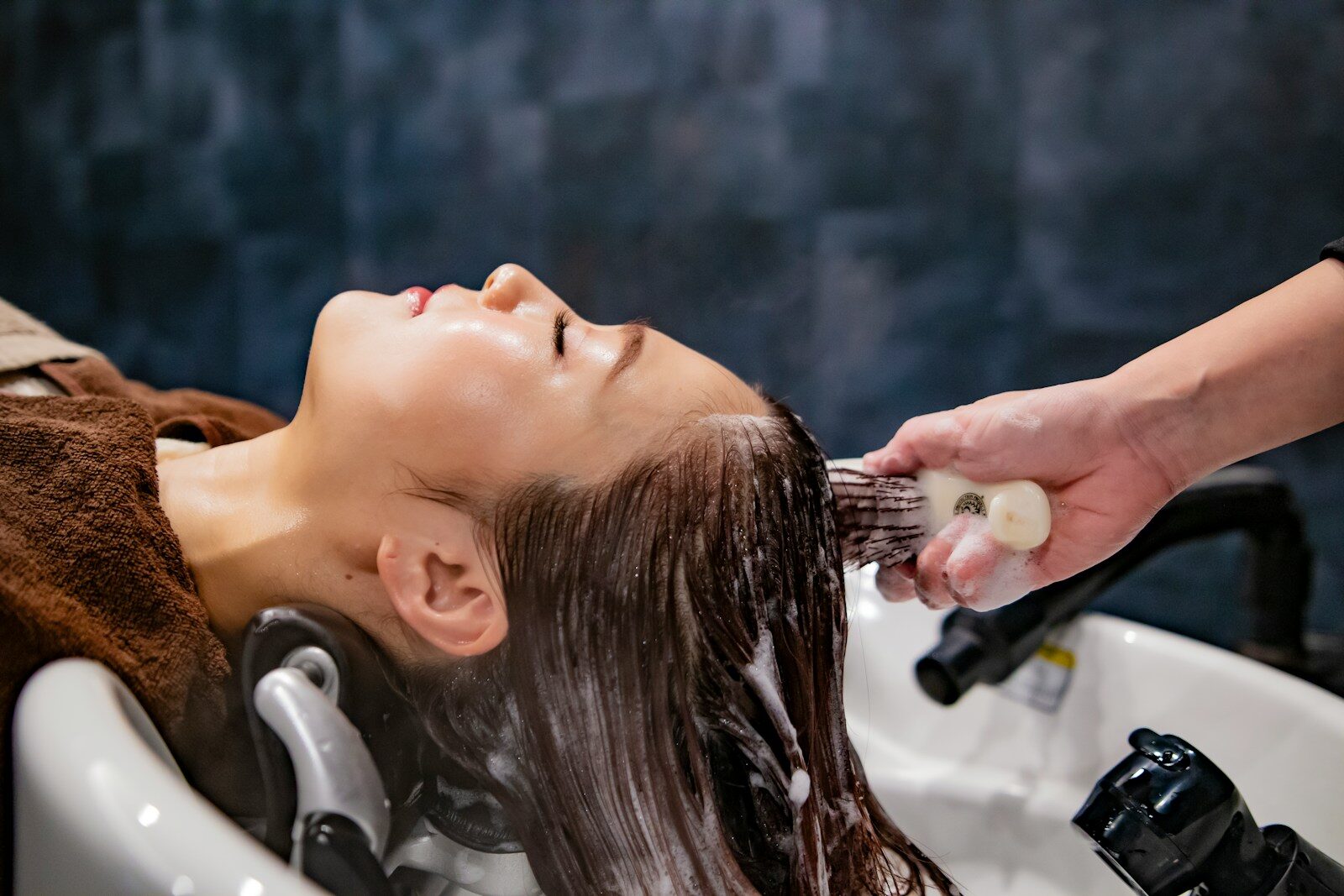
The scalp is the most washed skin on the body, and washing is the single largest daily stress its barrier faces. Every wash is a trade: surfactants remove sebum, dirt and styling residue, and in doing so they also remove some of the lipid mortar that holds the stratum corneum together. A healthy barrier rebuilds that mortar between washes. A strained barrier does not keep up, and the deficit accumulates into flakes.
Three washing habits matter most. The first is water temperature. Hot water strips lipids faster than lukewarm water and raises the scalp’s water loss after rinsing, which is why the tight, dry feeling peaks after a hot shower. Lukewarm water cleans just as effectively and costs the barrier far less.
The second is surfactant strength. A shampoo that leaves the scalp feeling “squeaky clean” has removed more than dirt — it has removed the surface lipids the barrier needs. The squeak is the feeling of a stripped surface. Gentler, sulphate-free or low-surfactant formulas clean without that cost, and they are the right default for a flaking scalp, even though they feel less dramatic in use.
The third is washing frequency and technique. Daily washing is fine for a healthy scalp, but a flaking scalp often benefits from washing less often and more gently — massaging with fingertips rather than nails, letting the shampoo sit briefly rather than scrubbing, and rinsing thoroughly so no residue remains to irritate. The parallel is the skin of the hands and cuticles, described in the companion post on the barrier you wash away every day: the same daily washing that keeps skin clean is also the daily stress that wears its barrier down, and the answer in both cases is gentleness, not more washing.
There is also a seasonal dimension. Cold air outside and heated air inside raise water loss from every surface, and the scalp is no exception — which is why flakes so often appear in winter and fade in summer. A winter scalp routine should be gentler than a summer one, not stronger, because the barrier is already under seasonal strain.
Prosumer Application: A Barrier-First Scalp Routine
A prosumer routine for the scalp follows the same barrier-first logic as the facial routine, adapted to a surface under hair. Four rules carry it.
First, diagnose the flake before choosing the product. Small, dry, white flakes in winter point to dryness — gentler washing and a leave-on barrier treatment. Large, adherent flakes point to the keratin pathway — urea, used at label strength. Oily, clustered flakes near the hairline point to the oil pathway — salicylic acid once or twice a week, never daily. Itch with pinkness points to irritation — remove the newest product first and simplify the routine.
Second, wash lukewarm and gentle. Choose a low-surfactant shampoo as the daily default, wash with fingertips, and reserve any active wash for its scheduled day. If the scalp feels tight after washing, the wash is too strong, whatever the label promises.
Third, treat the scalp as skin, not hair. A leave-on scalp treatment — panthenol for comfort, niacinamide for barrier support — works on the surface that actually flakes, while a conditioner works on the hair shaft. Part the hair so the product reaches skin, and give it time to absorb rather than rinsing it away.
Fourth, reset before you escalate. When a scalp has been over-washed, over-treated, or scrubbed into a flaking cycle, the correct move is usually to simplify, not to add a stronger active: a gentle wash, a plain leave-on treatment, and two weeks of patience. Within Skin001’s formulation framework, this is the role of RESERUM™ — a reset base for over-exfoliated-feeling skin, applied here as the logic of the reset itself: restore the seal, calm the surface, and only then reintroduce actives one at a time.
Introduce one change at a time, and judge it over four to six weeks — a full scalp renewal cycle — before deciding it failed. Flakes that worsen, spread, or come with pain, swelling, or patchy hair loss are not a routine problem: they are a reason to see a clinician, and a good routine includes knowing where its own limits are.
FAQ
Why does my scalp flake more in winter?
Cold air and indoor heating both raise transepidermal water loss, and the scalp barrier thins under that strain. The flakes are the visible sign of a lipid seal under pressure, which is why a gentler winter routine — lukewarm water, a low-surfactant wash — usually helps more than a stronger shampoo.
Is flaking the same as dandruff?
Not exactly. Flaking is a visible symptom with several causes — dryness, keratin buildup, oil-driven turnover, or irritation — while dandruff is a specific, oil-driven flaking pattern. Reading which kind of flake you have matters more than the word on the bottle: each pathway responds to a different ingredient.
Should I wash my hair more often if it flakes?
Usually no. Over-washing strips the lipid seal and can increase both oil production and flaking in a rebound loop. Wash when the scalp needs it, with a gentle formula, and let a leave-on treatment do the barrier work between washes.
Can I use facial skincare ingredients on my scalp?
The ingredients overlap — urea, niacinamide, panthenol and salicylic acid all work on scalp skin — but the vehicle matters. Leave-on scalp treatments are formulated to reach skin through hair, while facial creams sit on top of it. Use scalp-specific formats and follow the label’s own directions.
The CTA
The scalp is skin, and it follows the same rules as the rest of your skin: protect the lipid seal, read the symptom before choosing the ingredient, and let gentleness do the work that force cannot. Scalp barrier flakes are not a verdict on your hygiene or your shampoo budget — they are information about a barrier under strain, and a strained barrier can be rebuilt. To explore the barrier-first compounds and bases behind this approach, visit Skin001’s pure compound ingredients and bases and start with the gentlest step that matches your scalp.